First Lead Yourself
Ideas are not Theories
LIFT Principle: The best leaders don’t defend every idea they have. They test every idea they have.
7/8/20262 min read
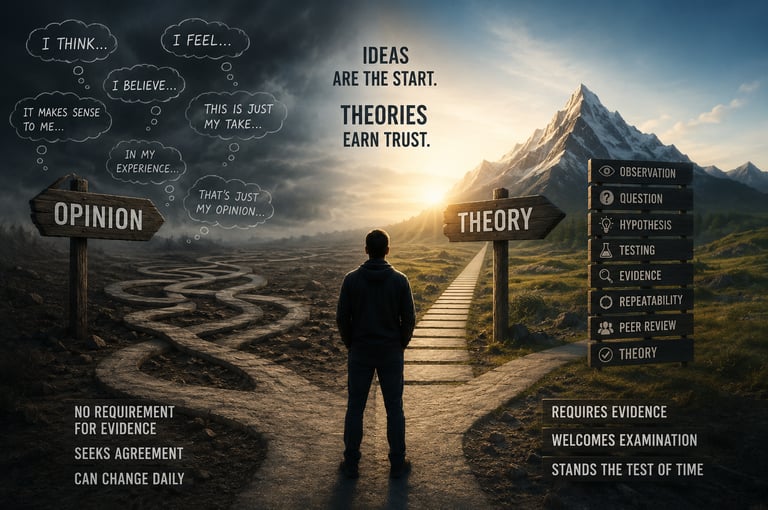
Many people equate their opinions with theories… but these two things are not the same. Of course, we must first understand what a theory is. For example, when we hear a suggestion outside of scientific discussions and academia, many times we dismiss it as “that’s just a theory.” Properly understood, a theory is not merely someone’s opinion. It is an explanation which has survived repeated testing against reality.
Like anyone else, I am capable of conjuring up explanations which make sense to me and to which I am fully committed, even though I may be incorrect. My ideas, sadly, are not correct ONLY because I thought them. They are correct only when they align with realities, whether or not I recognize it from the outset. Your opinion has a few miles to go before it attains the credibility ascribed to theories which have survived the scrutiny of evidence, observation, and reality over time.
Our opinions are formed from our experiences. Our emotions. Our assumptions. Our education and upbringing, and sometimes, even our preferences. For example, I think beans of any kind are horrible — but medical evidence points to a much different reality. So, while I avoid their consumption, my opinion (beans are inedible) can create problems that a theory demonstrated by nutritional science (beans are good for me) could have helped me to avoid. What this tells me is that my opinion needs no proof to exist — it only needs me to hold on to it.
A theory is a different thing entirely and often begins with an idea. That idea becomes a hypothesis—a proposed explanation that can be tested. As repeated testing and observations continue to support it, that hypothesis may eventually develop into a theory that consistently explains what we observe. The repeatability of the evidence is what gives the theory credibility.
Each of us is capable of thought and we can imagine possibilities and develop explanations which reinforce what we want to believe. We often mistake confidence for evidence, while simultaneously smiling at someone who believes their commitment to an idea is capable of transforming it into truth.
Opinions seek validation. Theories welcome examination because results can be tested. We need to get past the point of thinking our ideas are bulletproof when they are faltering. Being stubborn is not the same as being intuitive. Our ideas must correspond to reality.
When what we are doing is not working, reconsider ideas that are different, even if they come from sources with which we disagree. Reality never bends to our imagination.
Successful leaders are particularly susceptible to thinking their ideas are best. Leaders are often promoted because they have produced good ideas. But, having one good idea does not mean every idea is good. We are not rendered incapable of bad ideas simply because we had a good one. Conviction and confirmation should not be confused, and being “convinced” of something does not mean it is a fact. History reminds us you can hold ideas with passion, but they can still be spectacularly incorrect.
Gravity existed before anyone defined it.
Reality has never required permission to be true.
Wisdom demands we begin by asking “What is true?” rather than “What do I believe?” We should continually compare our opinions to evidence and adjust them where necessary. Let evidence, not preference, be your guide.
Mature leaders hold loosely to opinions, especially their own. Changing your mind is not weakness; it is intellectual honesty. Revisions are part of growing, and sometimes a complete reversal of one’s stance will be required for success.
Leadership is not the ability to produce ideas.
Leadership is the humility to submit your ideas to reality.